Underground Oil Tank Removal In Islip, NY
What the work involves, who signs it off, and what you are holding when it is finished.
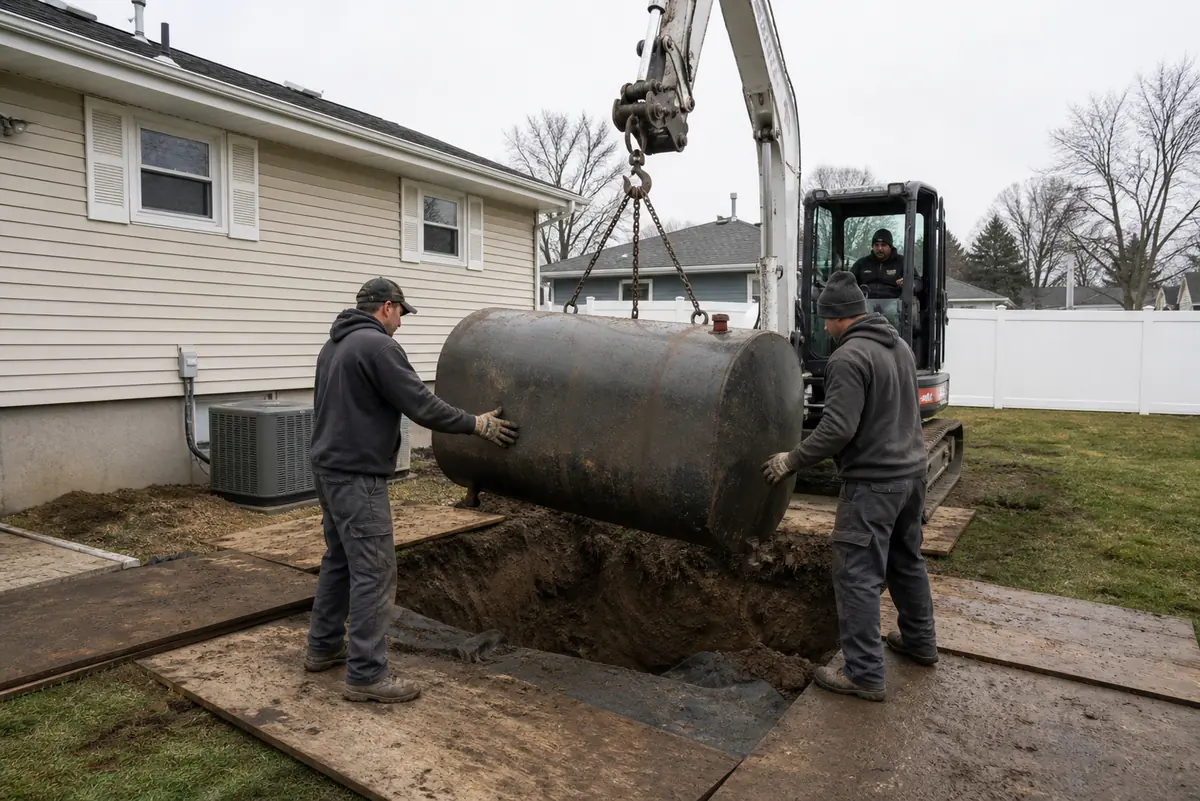
What matters before the work starts.
Removal is the default closure in Suffolk County and the one that ends the question permanently. A removed tank cannot be rediscovered by a buyer's inspector in four years.
What The Standard Actually Requires
New York rule names the codes of practice a closure is measured against: API RP 1604 and PEI RP 1700. To remove a tank, all liquids and accumulated sludge come out before the tank leaves the ground, and every line is disconnected and removed or securely capped.
That is the technical floor. It is the same in Islip as anywhere else in the state, which is why it is not what distinguishes one contractor from another.
6 NYCRR 613-2.6(b)(5), naming API RP 1604 (March 1996) and PEI RP 1700 (2018 edition).
The Permit And Who Issues It
For a #2 home heating oil tank the Town of Islip routes the work to the Building Division on a Plumbing / HVAC Permit, not to the Fire Marshal. Diesel and gasoline dispensing tanks go to Fire Prevention instead.
The Town Code sets a fire permit threshold at more than 60 gallons of combustible liquid but expressly exempts fuel oil tanks of 1,000 gallons or less that supply heating units only, which is why an ordinary house tank takes the building route.
Town of Islip guidance When is a Permit Required, stamped June 16, 2025; Town of Islip Code section 19-80.D.
Where The Tank And The Soil Go
A tank removed as junk has to be rendered vapor free and perforated so it cannot be put back into service. The tank, the residual oil and any impacted soil leave the site in a vehicle holding a New York State waste transporter permit.
We give you the transporter's permit number with the paperwork. It is the part of the chain of custody an underwriter can actually check.
Suffolk County Sanitary Code 760-1210.I.1.a; 6 NYCRR Part 364 waste transporter permit.
When The Ground Is Not Clean
If there is evidence of a release, the two hour reporting duty starts and the job changes shape. Scope then depends on how much soil is affected and how deep the water table sits, which on Long Island is the reason this matters more here than in most places.
We do not quote a remediation figure before anyone has seen the ground. What we will do is tell you what the published Long Island ranges are and how far apart they sit, which is on the cost page.
Questions On This
- How long does a straightforward removal take on site?
The excavation and removal is usually a single visit. The elapsed time on a file is driven by permit issue and, where soil was sampled, laboratory turnaround, so tell us the closing date first if there is one.
- Will the driveway or lawn be put back?
Reinstatement is agreed in writing before work starts, because it is one of the four things that moves a price. Ask for it to be itemized on the quote rather than assumed.
- Can I remove the tank myself?
The permit, the closure standard and the disposal chain all still apply, and any release you find carries a two hour reporting duty regardless of who dug it up. Homeowners also cannot produce the transporter permit number that an underwriter is looking for.