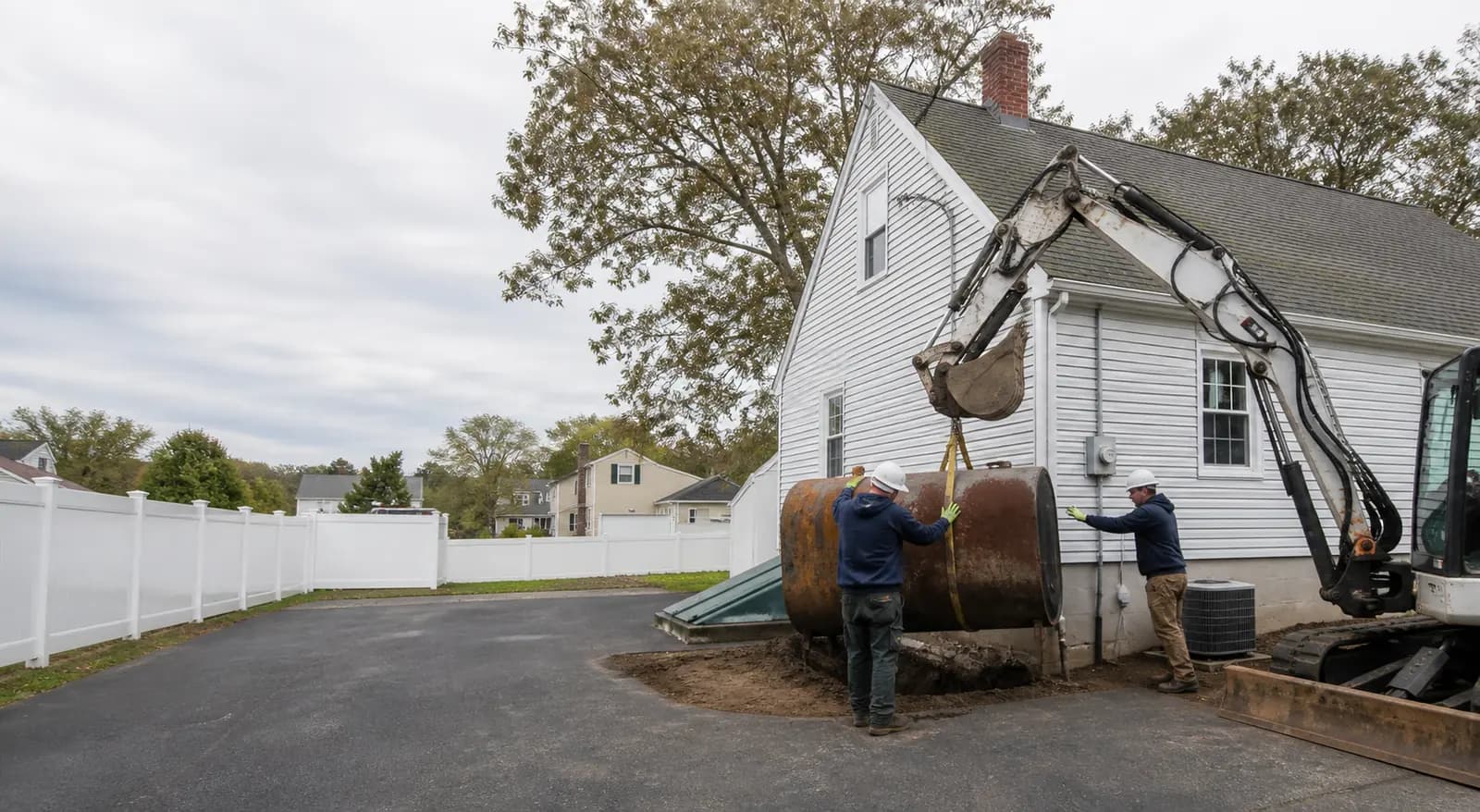
Oil Heat In The Town Of Islip
See what the work costsA buried tank is not a rare problem here. It is the default condition of a mid century Long Island house.
- 36,075
- Islip households still heating with fuel oil, 36.1 percent of the town
- 41.9%
- Suffolk County households on fuel oil, effectively tied with gas
- 76.4%
- Islip housing units built before 1980, against a 15 to 20 year tank life
American Community Survey 2024 one-year estimates, Town of Islip and Suffolk County.
Why A Lender Or Insurer Flags An Oil Tank
The tank itself is rarely the problem. What stops a file is that nobody can prove what happened to it, so an underwriter treats an unknown buried tank as an open liability and declines to move until that changes.
The fix is documentary. You are producing evidence that the tank was emptied, closed to a recognized standard and signed off, which is what the closure paperwork is for.
Oil Tank Removal Cost In Islip And Suffolk County
Long Island companies publish wildly different numbers for the same job. Aboveground removal appears at $408 to $1,001 on one site and $500 to $1,500 on another, while underground removal with nothing found sits at $2,500 to $5,000.
Those are other companies' published figures, not ours, and the spread is the honest answer to why nobody quotes a flat price sight unseen. The full breakdown of what actually moves the number is on the New York cost page.
Ranges read from the companies' own websites on August 13, 2026. Sources named in full on the cost page.
The Certificate Of Occupancy Test
In Islip the question of whether you need a permit has a specific answer that most homeowners never find. The Town's own permit requirements state that a permit is required to remove any oil tank that is listed on a Certificate of Occupancy.
So the CO is the test, not something you go and apply for. We pull the CO for the property first and tell you which side of that line you are on before any work is scheduled.
Town of Islip Plumbing / HVAC Permit Application and Requirements, note 7. Checked August 13, 2026.
Abandonment In Place Under Suffolk County Rules
Filling a tank with sand or foam is not a free choice here. Under the Suffolk County Sanitary Code, an in place closure can only be done by special permission from the Department, on an application demonstrating the absence of leaks, and after an inspection carried out at the owner's expense.
Removal is the default and abandonment is the exception. Anyone offering to foam your tank without mentioning that condition is describing a different county's rules.
Suffolk County Sanitary Code Article 12, section 760-1210.I.1.e. Verified against the County's own document, August 13, 2026.
The Two Hour Clock If Something Is Found
If a release is discovered, it must be reported to the New York State Spill Hotline within two hours of discovery. That duty reaches homeowners directly, because holding title to a tank system is enough to trigger it, even though a house tank under 1,100 gallons is not a registrable state facility.
We report it, and we tell you we are reporting it. There is a narrow exemption for a spill under five gallons that is contained and cleaned up within two hours, and we will tell you if you are in it.
6 NYCRR Part 613, section 613-2.4(e), reach extended to tank system owners by 613-1.2(c). Spill Hotline 1-800-457-7362.
What The Job Leaves You Holding
A closed permit with the Town of Islip Building Division, the tank disposal record, and where soil was sampled, the laboratory results. That package is what gets sent to the underwriter or the attorney.
If the file needs to satisfy a closing date, tell us the date first. The paperwork sequence is what takes time, not the excavation.
Where We Work In The Town Of Islip
Bay Shore, Central Islip, East Islip, West Islip, Islip Terrace, Sayville, West Sayville, Oakdale, Bohemia, Holbrook, Holtsville, Ronkonkoma, Brentwood, Hauppauge and Great River. These are unincorporated hamlets, so their permits are issued by the Town.
Brightwaters and Islandia are incorporated villages and run their own permitting, which changes the process rather than the price. Some hamlet names also straddle the Brookhaven and Smithtown lines, so we check the parcel's tax map number rather than trusting the mailing address.
Town of Islip Code section 68-21.B limits the Town Building Code to areas outside the limits of any incorporated village.
Oil Tank Removal Near Me In Islip
If you searched from an Islip address, the practical question is which authority signs your job off and what the buried tank does to your disclosure obligations. Both are answered on this site with the code sections cited.
Send the address and what is holding things up. You get a written figure and a date.
Common Questions From Islip Owners
- Do I have to remove an oil tank in Islip?
There is no blanket state requirement to remove a residential tank where there is no sign of a release. What creates the obligation is usually a third party: a lender, an insurer or a buyer. Separately, if the tank is listed on your Certificate of Occupancy, a Town of Islip permit is required to remove it.
- What does the Town of Islip permit cost?
The Town's residential fee schedule lists Oil Tank Demo, Abandonment, Replacement or Installation at $160 each. That figure is from the schedule effective May 1, 2024, which was the current published schedule when we checked on August 13, 2026. Fees are set by the Commissioner rather than written into the Town Code, so confirm it with the Building Division before you rely on it.
- Can I just fill the tank with sand instead?
Not as a matter of choice. Suffolk County allows an in place fill only by special permission, on an application demonstrating the absence of leaks, and after an inspection at the owner's expense, or where complete removal is unreasonable such as under a building foundation.
- Does my tank have to be registered with the state?
A heating oil tank under 1,100 gallons, used on the premises, not interconnected to another tank, and on a property with no other qualifying tank system, is excluded from the definition of a facility and is not a registrable petroleum bulk storage facility. That exclusion is at 6 NYCRR 613-1.3(x)(2)(iv).
- Is there grant money for oil tank removal in New York?
No. There is no New York State grant for residential oil tank removal. Suffolk County Code does establish a $100 incentive for closing a residential fuel oil tank of 1,100 gallons or less, but the code makes it subject to the availability of appropriations, so confirm with the Department of Health Services that it is currently being paid before counting on it.
- Do I have to tell a buyer about the tank?
Yes, in writing. Since March 20, 2024 New York sellers can no longer opt out of the Property Condition Disclosure Statement with a credit, and Question 21 asks directly whether there are or have ever been fuel storage tanks above or below the ground on the property.